

Nineteenth-century emergence of a seafloor ecosystem beyond glacial-interglacial limits
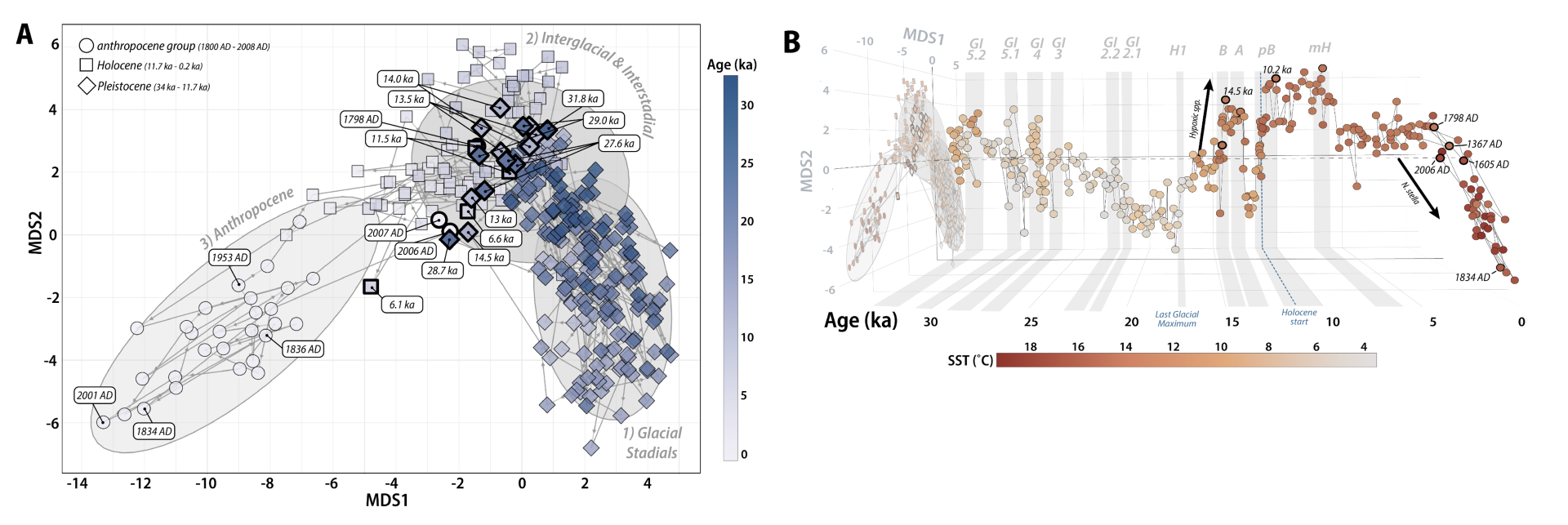
The timescales of global change complicate our ability to effectively compare contemporary ecosystem changes with those of the past. Mismatches between ecological time and geologic time have fueled intense debates around what constitutes baseline conditions and whether the recent past is truly unique. In this talk, I will show results from a recent study using sub-decadal paleontological and paleoceanographic data from a series of sediment cores from the Santa Barbara Basin (SBB) of Southern California to assess the evolution of benthic ecosystem structure over the past 34,000 years, across the rapid warming events of the glacial-to-interglacial transition. Beginning in the early 1800s AD, I find that communities abruptly moved to a distinctive ecosystem space and became more ecologically variable than at any point in the last 34,000 years. These results indicate that even deep-sea ecosystems of the anthropocene sensu lato – the past few centuries characterized by outsized, often novel human impacts – are distinct from those of the geologic past. I also find that human land-use impacts beginning in the 19th century are correlated with compositional change and heightened variability and may have kickstarted ecological declines that were later exacerbated by global climate warming in the 20th and 21st centuries. Together, this work suggests that colonial-era human land-use change drove the emergence of a novel ecosystem state more than a century before global climate warming began in earnest, at a scale of deep-sea ecological impact that exceeds those induced by the glacial-interglacial transition.
Dr. Sara Kahanamoku, Assistant Researcher, Hawaiʻi Sea Grant College Program & Department of Earth Sciences
Dr. Kahanamoku is a geologist and ecologist who uses sediment core records from nearshore reefs to the deep sea to build high-resolution multi-proxy datasets that capture the impacts of climate warming and human modifications on marine ecosystems over the “intermediate timescales” relevant to modern global change. As a Kanaka ʻŌiwi (Native Hawaiian) and Maʻohi (Indigenous Tahitian) scientist, Dr. Kahanamoku is guided by the values of their kūpuna, including the view that an understanding of the past is critical for long-term ecological and social resilience. To date, they have raised close to $70 million in external funding and currently serve as co-PI on a five-year climate resilience award that brings together community, county, state, federal, and academic partners to develop a long-term program for Indigenous-led climate adaptation and resilience in the Hawaiian Islands. Dr. Kahanamoku holds a BS in Geology & Geophysics from Yale University and a PhD in Integrative Biology from the University of California at Berkeley and is currently an Assistant Researcher at the University of Hawaiʻi at Mānoa with faculty positions in the Hawaiʻi Sea Grant College Program and the Department of Earth Sciences.