
Angel Manuel De Dios López
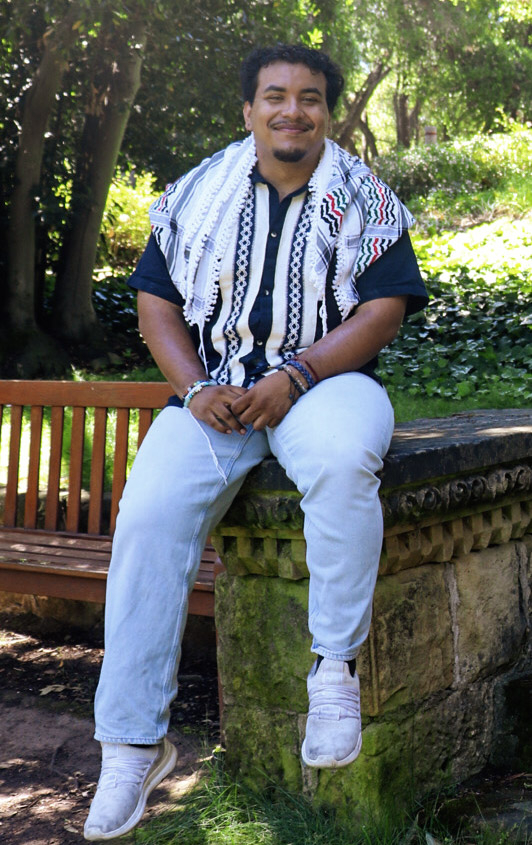
Biography
Education
2026 M.A. Earth Systems (Concentration in Environmental Communication), Stanford University
2026 B.A. with Honors in Urban Studies (Concentration in Urban Society and Social Change) and Comparative Studies in Race and Ethnicity (Concentration in Race, Space, and Belonging), Stanford University
Research
I am researching the intersections of memory, borders, and water at the Imperial-Mexicali Borderlands. Taking a transfronterizx approach, I hope to study how spatial memory of water may inform the political ecologies of the region.
In my undergraduate thesis, I asked and answer the following question: how has settler colonialism shaped the geography of the Colorado River at the U.S.-Mexico Border? By framing it through a transborder analysis, the thesis observes both sides of the border to understand the geography. To further the conversation, this thesis delves into a theory of sedimentation, proposing that colonialism builds upon each layer, and that using a transborder analysis of each layer helps us see how the colonial process persists today. This thesis delves into the beginning of colonialism to the 1970s. The thesis proposes colonization layers over time in two stages: 1) the river’s terraformation through visualization and materialization, 2) the river’s allocation of waters to prioritize settlement, state-building, and the extractive industry of the metropole. Drawing on archival materials, the paper discusses the colonial histories of the Colorado River in the U.S.-Mexico borderlands.
In summary, the thesis asks: How has the sedimentation of colonialism manifested itself in the Colorado River? How has settler colonialism shaped the geography of the Colorado River at the U.S.-Mexico Border? And how may those histories inform present-day engagement of the river?
Political Ecologies, U.S./// Mexico Borderlands, Decolonial Theory, Critical Geographies, Environmental Justice, Abolitionist Theory, Social Change, Water Justice
Selected Publications
Undergraduate Thesis:
De Dios López, A. M. (2026). The Nile of the West : Transborder/transfronterizx analysis on the sedimentation geographies of colonial extraction at the Colorado River [Unofficial Link]. Stanford University.
Public-Facing Publications:
De Dios López, Angel M. “Mutual Aid & Occupation: Calexico’s Farmworker Encampment.” ArcGIS StoryMaps, 29 May 2026, storymaps.arcgis.com/stories/d4a6721f5644446880c738990b1eb52f.
Grants & Awards
- LCOY Mexico 2026 Baja California Representative
- Cumbre Climática Juvenil en Baja California Certificate
- Eugene Cota-Robles Fellow 2026
- William W. Whitley Citizen Scholar
- First Generation and/or Low Income Unity Award
- Dorothy Steele Award for Community Outreach, Engagement, and Social Justice
- Stanford In Government in Partnerships with Environment and Policy Internships (EPIC) Fellowship
- Partnerships for Climate Justice in the Bay Area Fellowship
- VPUE Major Grant Recipient
- Gates Scholarship Recipient
Courses & Presentations
Courses:
Climates of Inequality Spring 2026 – Teaching Assistant (EARTHSYS 220A – Stanford University)
Just Transitions Policy Lab Winter 2026 – Lead Instructor (EARTHSYS 119 – Stanford University)
Just Transitions Policy Lab Winter 2025 – Co-Instructor (EARTHSYS 119 – Stanford University)
Building Alliances for Water Justice: Case Studies from California Spring 2024 – Teaching Assistant (EARTHSYS 1666 – Stanford University)
Just Transitions Policy Lab Winter 2024 – Co-Instructor (EARTHSYS 119 – Stanford University)
Presentations:
American Association of Geographers, San Francisco, CA, Geographies of Extraction and Consumption, 10-minute Presentation on my senior honors thesis titled: From Terraformation to Lithium Extraction: Exploring Anthropocentric Colonial and Neocolonial Activity within the Colorado River at the US-Mexico Borderland, March 19, 2026.
1er Congreso de Justicia Ambiental de la Frontera Panelist and Co-organizer, Mexicali, México, Water Justice at the Border, 70-minute Panel Session on Water Justice at the Border in Mexicali & Imperial Valley, December 13, 2025.
Stanford School of Humanities, Stanford, CA, Cotton Technologies: A Fiber Optics & Environmental Humanities Workshop, Cotton Within the Borderlands: Historical Implosion Exercise, May 16th, 2025.